
Beyond Cleanup: Strategically Organizing Your Canvas Content Library for Future Readiness
Many institutions face the challenge of inheriting disorganized content within their LMS, especially when considering migrations, new integrations, or scaling operations. This guide provides instructional designers and Canvas administrators with actionable strategies to proactively organize, tag, and structure their course content library, ensuring discoverability, reusability, and seamless transitions for future educational technology shifts.
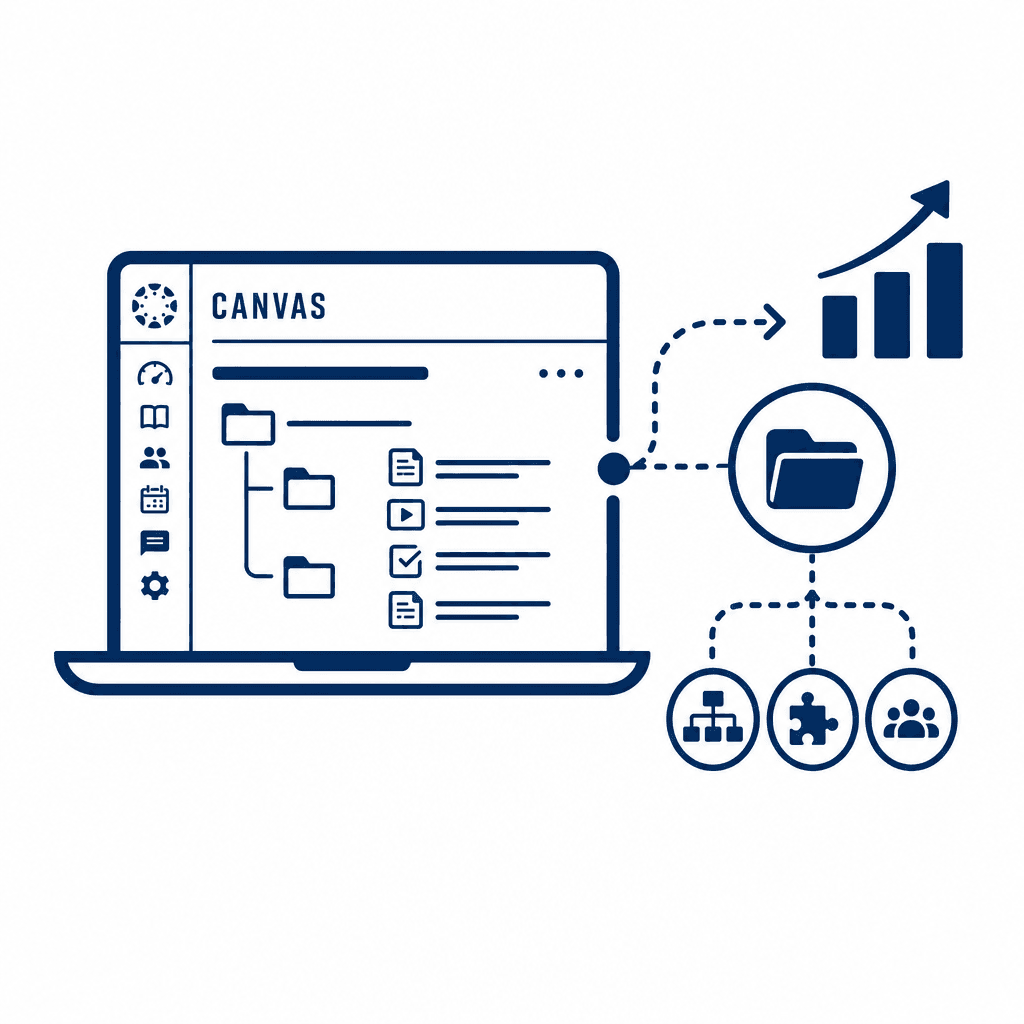
Organizing digital content within the Canvas LMS is crucial for educational institutions aiming to streamline course design and administration. As institutions face transitions like migrations or new integrations, establishing a solid information architecture and effective content management strategies can enhance discoverability and facilitate future scalability. This article delves into actionable methods for professionals tasked with these challenges.
Understanding the Importance of Content Organization
Understanding the Importance of Content Organization Organizing course content within the Canvas LMS is essential for promoting effective teaching and learning. Disorganization leads to significant impediments, such as inefficient content retrieval and frustrating user experiences. When instructors struggle to locate materials swiftly, their time spent searching detracts from valuable teaching moments, negatively impacting learning outcomes. Institutions face challenges like outdated materials and difficulty repurposing content for new courses. Research indicates that up to 30% of course materials are redundant or irrelevant, which can confuse both instructors and students alike. A disorganized content library hinders an instructor's ability to adapt to changing pedagogical approaches, especially when integrating new technologies. Moreover, a chaotic content landscape affects students directly. They may find it hard to navigate course resources, leading to disengagement and unmet educational objectives. Proper organization is not merely a convenience; it significantly influences student success and retention rates. By prioritizing content organization, educational institutions can foster an enriching learning environment that supports both instructors and students in achieving their goals. This underscores the necessity for a strategic approach to content management, setting the foundation for future-ready educational experiences.
Evaluating Current Content State
Assessing the current state of your Canvas content library is an essential next step toward future-proofing your educational resources. Conducting a thorough content audit will not only reveal outdated materials but also identify gaps in course offerings and redundancy that hamper a seamless learning experience. Begin by establishing criteria for what constitutes relevant, high-quality content—factors such as alignment with learning outcomes, currentness, and applicability to your target audience. Utilizing tools like Canvas Analytics, you can evaluate engagement metrics to pinpoint which materials are frequently accessed and which are seldom used. Surveys or interviews with instructors and students can provide invaluable qualitative insights. Collaborating with stakeholders—such as faculty members and instructional designers—will ensure diverse perspectives are considered in your assessment efforts. As you analyze the data, categorize the content into three sections: keep, update, or retire. Focus on not only the quantity of resources but also their quality and relevance. This data-driven approach will inform your next steps in organizing the content library—laying the groundwork for a more structured and efficient framework that supports content discoverability and reusability in future educational technology initiatives.
Creating a Robust Information Architecture
Creating a robust information architecture within your Canvas LMS is crucial for enhancing the efficiency and effectiveness of content management. Start by establishing a clear **hierarchical structure** that reflects the educational objectives and course design principles. For instance, organizing content into categories such as “Course Materials,” “Assignments,” and “Assessments” offers intuitive navigation for both instructors and students. Utilize **metadata** to enrich the content with descriptive attributes, thus facilitating easy retrieval. Metadata can include information like author, creation date, learning outcomes, and course alignment. This added layer will help in quickly locating relevant materials during course development and reviews. Adopting a **thematic organization** can also enhance the user experience. For example, grouping content by module or topic within a course ensures that related materials are easily accessible, promoting deeper learning. Incorporate best practices from established content management frameworks such as the **Dublin Core** or the **Learning Resource Metadata Initiative (LRMI)**, which foster standardization in metadata usage. By prioritizing a well-structured information architecture, you set a strong foundation for ongoing content migrations and future adaptations within the evolving educational landscape.
Implementing Effective Tagging Strategies
Implementing a tagging strategy within your Canvas LMS is crucial for optimizing content organization and enhancing discoverability. Tags serve as vital metadata that transforms unstructured content into easily retrievable resources. Developing a consistent tagging protocol not only streamlines content management but also fosters collaboration among instructors. To create an effective tag taxonomy, begin by identifying core areas of focus, such as subject matter, skills, and difficulty levels. For instance, tags can be categorized as follows: - **Subject-Based:** Tags like "Mathematics," "Biology," or "Literature." - **Skill-Based:** Tags such as "Critical Thinking," "Data Analysis," or "Creative Writing." - **Level-Based:** Tags indicating "Introductory," "Intermediate," or "Advanced." These tags facilitate structured navigation, allowing instructors to quickly locate relevant materials when designing courses. A consistent tagging framework ensures that regardless of course changes, content remains aligned with educational goals. Instructors can harness these tags during course development by incorporating them into lesson plans and assessment criteria. This practice not only accelerates content retrieval but also enhances the academic experience, enabling learners to engage with tailored resources that match their specific needs and learning paths. By reinforcing a disciplined tagging approach, institutions can cultivate a rich, future-ready content ecosystem within Canvas.
Strategizing for Content Migration and Integration
As institutions move towards advanced educational technologies, careful migration of content within the Canvas LMS becomes critical. A common pitfall during this process is the failure to maintain the established organizational frameworks, leading to fragmented resources and lost opportunities for reusability. To navigate this, create a detailed roadmap that outlines key steps for a successful migration. First, conduct a thorough content audit. Identify existing materials and assess their relevance, quality, and alignment with current pedagogical standards. Next, categorize content into core, supplementary, and outdated resources. This classification provides a clear basis for determining what to migrate. During the migration, it's essential to implement checks for content integrity. Utilize version control systems and backup protocols to prevent data loss. Also, actively engage with faculty by providing training on newly integrated tools, ensuring they understand how to access and utilize organized resources effectively. Lastly, establish a feedback loop. By fostering an environment of continuous support and open communication, faculty members can share their experiences, helping shape future integrations in line with their needs, ultimately enhancing the learning experience in a cohesive manner.
Ensuring Long-Term Content Reusability and Scalability
Proactively maintaining a content library in Canvas LMS is crucial to ensuring that educational resources remain both reusable and scalable over time. Institutions must adopt sustainable content practices that foster continuous improvement rather than a one-time overhaul. This involves establishing a routine for ongoing content maintenance, where instructional designers and faculty regularly review and update course materials. Encouraging user feedback is essential in this process, as it provides insights into which resources are truly effective and relevant. By creating a culture of collaboration, faculty and administration can engage in constructive discussions, allowing for joint optimization of the content library. This approach not only facilitates a shared commitment to quality but also promotes a sense of ownership among faculty, ensuring that course design aligns with evolving pedagogical needs. Moreover, regular revisits to content ensure that outdated materials are phased out and replaced with innovative, evidence-based resources. Implementing an iterative review cycle, where content is evaluated at the end of each term or semester, supports this dynamic process. Ultimately, a well-organized content library within Canvas LMS is a living entity, adaptable to changing technologies and teaching methodologies, thereby enhancing the overall educational experience.
Conclusions
In summary, establishing a well-organized Canvas content library is not merely an exercise in cleanup; it lays the groundwork for future educational technology advancements. By implementing robust tagging, structuring techniques, and migration planning, institutions can ensure their course content is easily navigable and ready for upcoming challenges in the learning management landscape.