
Beyond Rapid Creation: Ensuring Deep Learning with AI-Generated Courses in Canvas
AI tools can quickly generate course content, but true learning takes time and thoughtful design. This article provides educators and instructional designers with strategies to move beyond mere content generation to ensure deep, meaningful learning experiences in Canvas courses created with AI assistance. It will cover pedagogical oversight, scaffolding, active learning integration, and assessment design that promotes critical thinking, even when content is rapidly produced by AI.
Understanding AI in Canvas
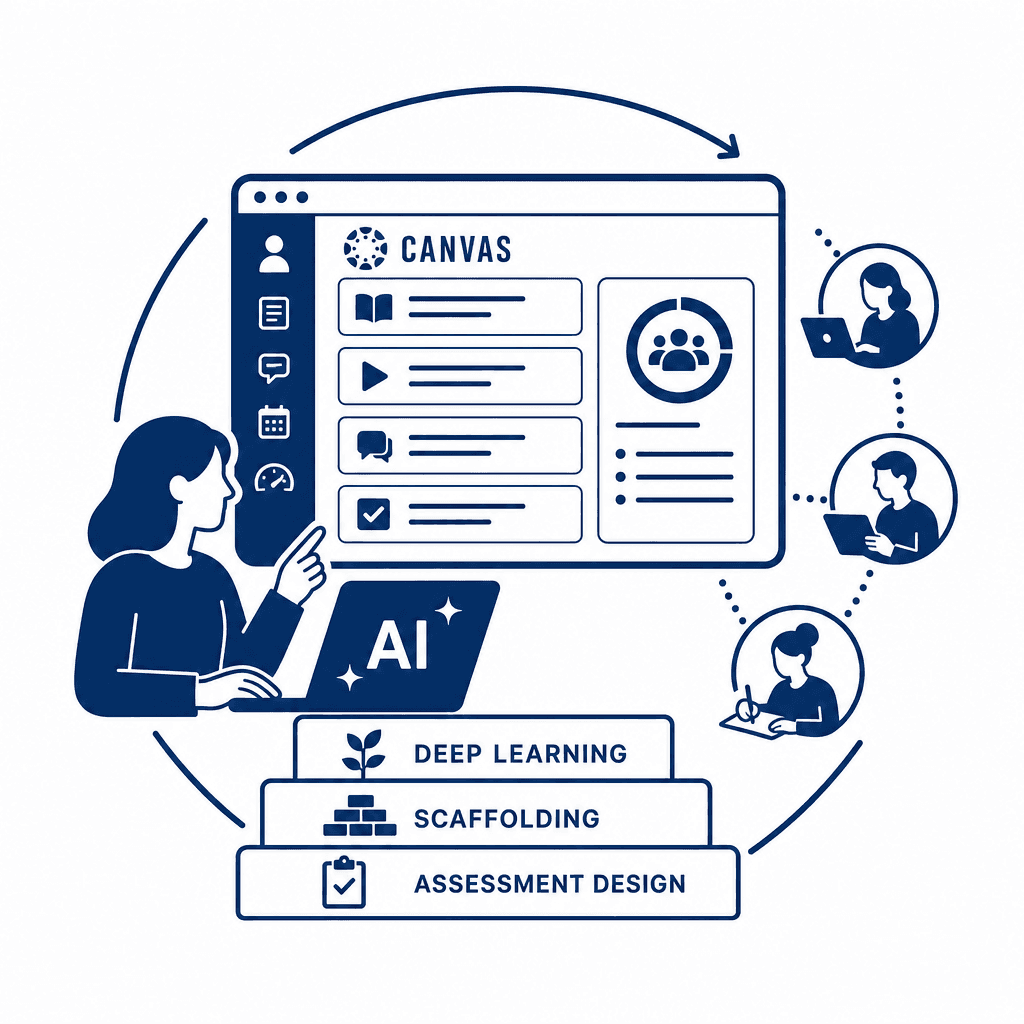
Understanding AI in Canvas: This chapter will delve into the role of AI in the Canvas learning management system. Discuss the various AI tools available for educators that facilitate course content generation and explore their capabilities and limitations. Highlight how these tools can save time for educators while also presenting challenges related to quality and engagement in course materials. The incorporation of AI in the Canvas learning management system offers educators powerful tools that significantly streamline course content generation. Platforms like Canvas LMS have integrated AI functionalities that can quickly create modules, quizzes, and even discussion prompts based on predefined parameters. For example, educators can utilize AI algorithms to generate readings or instructional videos tailored to specific topics, which can save considerable time during course development. However, these advantages come with notable limitations. While AI-generated content can be diverse and extensive, concerns regarding quality and engagement remain paramount. Automated text may lack the depth, nuance, and context that human-created materials possess, leading to potential gaps in learner understanding. Furthermore, without adequate monitoring, reliance on AI can inadvertently foster a disengaged learning experience, as students may encounter generic or repetitive content. Thus, while AI tools can enhance efficiency, educators must remain vigilant in curating and refining generated materials to maintain pedagogical effectiveness and foster genuine learning engagement.
The Importance of Pedagogical Oversight
The critical role of pedagogical oversight cannot be overstated in the context of AI-generated content for courses in Canvas. While AI can produce relevant materials swiftly, it is the educator's responsibility to ensure these resources align with specific learning objectives and pedagogical standards. This oversight begins with a thorough review of the generated content, assessing its accuracy, relevance, and appropriateness for the target audience.
One effective strategy for maintaining instructional integrity is the implementation of feedback loops. By actively seeking input from both students and colleagues, educators can gain insights into the effectiveness of the AI-generated materials. Regular revisions based on this feedback ensure that course content remains fresh, engaging, and tailored to the learners' needs. Moreover, it fosters a collaborative environment where peers can contribute valuable perspectives on the content.
Furthermore, establishing a routine for periodic updates and evaluations of the course materials is essential. This not only addresses any potential shortcomings in the AI-generated content but also keeps the educational experience aligned with the latest developments in the subject area. Ultimately, robust pedagogical oversight transforms AI-assisted learning into a rich, engaging, and meaningful educational journey.
Scaffolding for Success
Scaffolding is a vital strategy in course design, especially when utilizing AI-generated content. It serves to support students through a structured learning experience, preventing them from feeling overwhelmed by the rapid influx of information. By breaking down complex concepts into manageable parts, educators can guide students toward deeper understanding and proficiency. One effective method of scaffolding in Canvas is the use of sequential modules. Educators can organize course content into stages, where each module builds on the previous one, allowing students to gradually acquire knowledge and skills. Regular check-ins, such as formative assessments and reflection prompts, can encourage students to gauge their understanding and identify areas needing further review. Incorporating multimedia resources such as videos, infographics, and interactive quizzes within these modules can enhance engagement and comprehension. Additionally, leveraging Canvas's discussion boards allows students to articulate their learning, ask questions, and collaborate with peers, further reinforcing ideas as they progress. By thoughtfully structuring courses with effective scaffolding techniques, educators can ensure that students benefit from the AI-generated content while fostering an environment conducive to meaningful and lasting learning experiences.
Active Learning Integration
Active learning strategies are essential for creating engaging and effective Canvas courses that utilize AI-generated materials. These techniques promote student participation and ownership of their learning. One effective method is to facilitate group discussions. By prompting students to analyze AI-generated content collaboratively, they can critique and contextualize information, encouraging deeper understanding. Furthermore, peer assessment is an invaluable active learning tool. When students assess one another's work, they not only reinforce their learning but also develop critical evaluation skills that extend beyond the AI-generated material. Hands-on projects provide another avenue for active engagement. For instance, after receiving AI-generated simulations or case studies, students could work in groups to devise solutions or analyze outcomes, linking theoretical knowledge with practical application. This interactive format allows students to experiment and reflect on their learning process rather than passively consume information. Integrating these active learning strategies with AI content can transform the learning experience in Canvas. By fostering discussion, collaboration, and practical application, educators can help students not only absorb information but also synthesize and apply their knowledge in meaningful ways. This approach enhances comprehension and promotes a deeper connection to the subject matter.
Designing Assessments for Critical Thinking
The design of assessments in AI-assisted courses must focus on fostering critical thinking skills within students. While AI can generate content rapidly, the challenge lies in creating assessments that require students to engage thoughtfully with that material. Project-based learning stands out as an effective approach, allowing students to apply knowledge in real-world contexts, encouraging creativity, and deepening understanding. For instance, students might create a project that addresses a community issue, leveraging AI-generated data to propose solutions. Incorporating formative assessments is also crucial, as these evaluations offer ongoing opportunities for students to reflect on their learning process. Techniques like peer assessments and self-reflections can promote self-directed learning, making students active participants in their educational journey. Feedback plays a pivotal role; timely, constructive feedback helps students identify gaps in their understanding and encourages them to refine their critical thinking skills. Furthermore, assessments should include open-ended questions that require analysis, synthesis, and evaluation of information, promoting deeper cognitive engagement. By intertwining these assessment strategies with AI-generated content, educators can create avenues for reflection, discussion, and higher-order thinking, ultimately yielding a rich learning environment that extends beyond mere content consumption.
Creating Meaningful Learning Experiences
Creating meaningful learning experiences in Canvas requires a careful synthesis of technology and effective pedagogical strategies. While AI-generated content can expedite the course creation process, it is essential for educators to recognize that depth of understanding and engagement cannot be achieved through content alone. Intentional course design involves integrating active learning principles that foster student engagement and promote higher-order thinking. By embedding collaborative activities, discussion forums, and problem-solving tasks into the course structure, educators can motivate learners to take an active role in their education, leading to deeper cognitive processing.
Moreover, pedagogical oversight is crucial when integrating AI tools into course design. Educators must ensure that the AI-generated content aligns with learning objectives and is developmentally appropriate. This oversight ensures that learning pathways are scaffolded effectively, providing students with the support necessary to engage with complex concepts progressively. Assessment design must also reflect this intentionality—offering opportunities for students to demonstrate their understanding in varied ways fosters a more inclusive learning environment. Ultimately, the thoughtful incorporation of AI tools, when coupled with robust educational frameworks, prepares students not only to acquire knowledge but to apply it meaningfully, paving the way for lifelong learning and success.
Conclusions
In summary, leveraging AI to generate course content in Canvas presents vast opportunities for educators. However, true learning requires thoughtful design encompassing pedagogical oversight, scaffolding, active learning, and critical assessments. By integrating these elements, educators can move beyond mere content generation to create impactful and meaningful learning experiences for their students.