
Designing AI-Proof Assessments New Strategies for Academic Integrity in Canvas
With the limitations of AI content detectors, educators need new strategies for designing assessments that uphold academic integrity in the age of generative AI. This guide will explore innovative assessment types and pedagogical approaches within Canvas that make it difficult or irrelevant for students to use AI for unfair advantage, focusing instead on higher-order thinking, personalized tasks, and authentic demonstrations of learning.
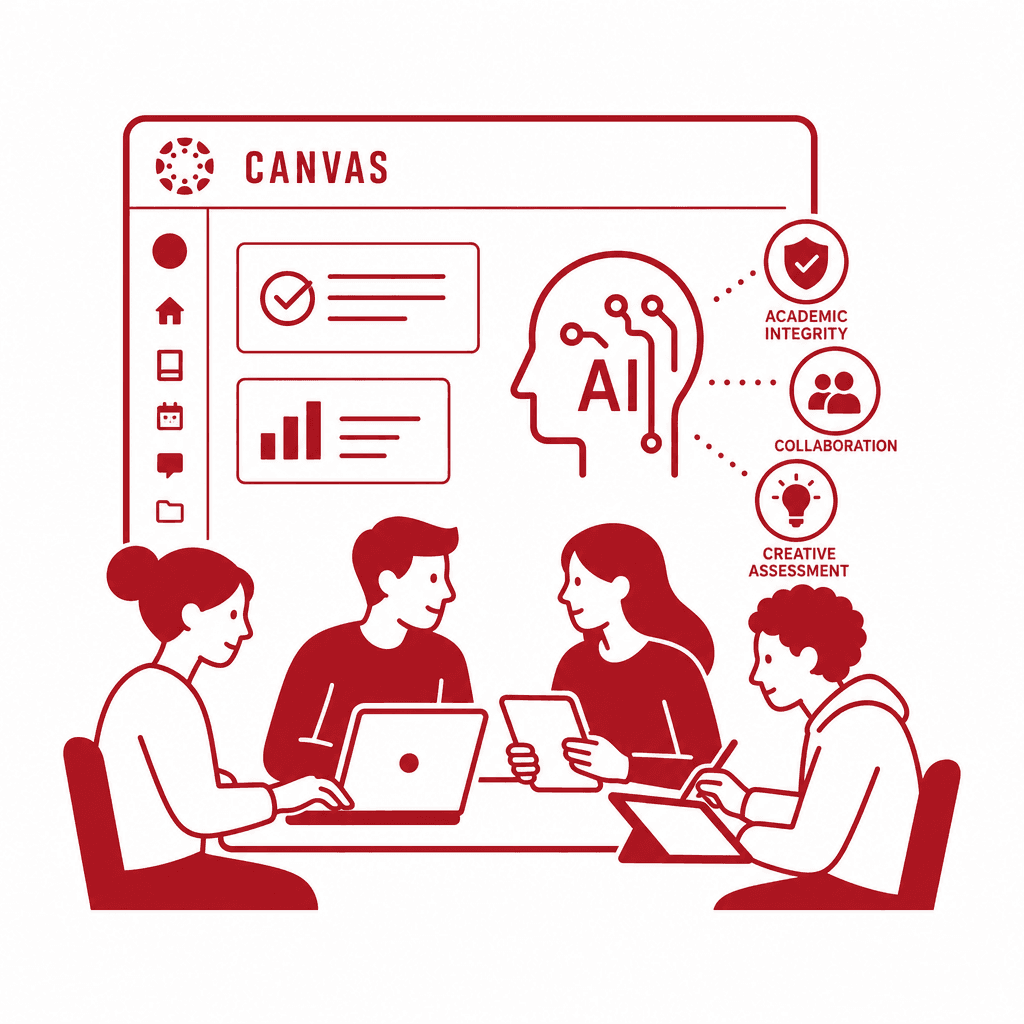
Understanding the Challenge of AI in Education
The emergence of generative AI has illuminated significant challenges in maintaining academic integrity, complicating traditional assessment methods. While AI content generation offers remarkable capabilities, it also risks undermining the foundational principles of learning and ethical behavior. Current AI detection tools are limited in scope, often failing to accurately identify AI-generated content due to their reliance on algorithms that can be easily circumvented. This poses a dilemma for educators, as reliance on such tools may create a false sense of security, misrepresenting students’ engagement with academic work. As educators grapple with these complexities, it becomes evident that the implications extend beyond mere detection of cheating; they fundamentally disrupt the learning environment. Students may be tempted to utilize AI assistance, viewing it as a shortcut rather than engaging in the meaningful, critical thinking processes that assessments are designed to promote. The challenges posed by AI compel educators to reconsider the dynamics of academic integrity, emphasizing the need for strategies that encourage ethical behavior and authentic learning experiences. Addressing these challenges effectively requires a shift in perspective—recognizing that the very nature of knowledge acquisition and demonstration is evolving in this new technological landscape.
Rethinking Assessment Design
As the landscape of education shifts in response to the capabilities of generative AI, effective assessment design requires a reevaluation of what constitutes meaningful evaluation. Essential to this evolution is a robust alignment between assessment tasks and learning objectives, ensuring that students engage in activities that foster higher-order thinking. Emphasizing critical thinking and complex problem-solving can create an environment where AI struggles to deliver satisfactory responses.
To achieve this, educators should focus on tasks that demand not just factual recall but also synthesis, analysis, and evaluation. For example, utilizing case studies that require students to apply theoretical knowledge in novel situations can help assess understanding beyond surface-level memorization. Project-based assessments that involve real-world applications allow for creativity and individual expression, making it less feasible for AI to generate relevant and contextually appropriate responses.
Furthermore, incorporating formative assessments that provide iterative feedback can guide student learning in a way that discourages reliance on AI tools. By fostering a culture of reflection and growth, educators can strengthen academic integrity and empower students to take ownership of their learning journey within the Canvas environment.
Personalized Learning Experiences
Personalization plays a crucial role in deterring academic dishonesty, particularly in an educational landscape increasingly influenced by generative AI. When assessments are tailored to individual students' interests and learning styles, they foster a deeper connection to the material, enhancing intrinsic motivation. This connection can make the idea of resorting to AI-generated work less appealing. To implement personalized learning experiences in Canvas, educators can consider techniques such as adaptive assessments, which adjust the difficulty based on a student’s performance, providing a bespoke challenge. This individualized approach not only caters to diverse learning needs but also creates a unique experience, disincentivizing reliance on AI tools. Alternatively, student-choice projects allow learners to select topics that resonate with their passions, promoting ownership of their educational journey. Tasks that require personal reflection or connection to real-world scenarios further bind students to the content, making generative AI's generic outputs inadequate. By cultivating assessments that speak directly to the learner’s interests and learning profiles, educators can create environments that prioritize authentic demonstrations of knowledge. This strategic shift not only strengthens academic integrity but also invites a richer, more engaging learning experience that AI cannot replicate.
Higher-Order Thinking Assessments
Shifting focus towards higher-order thinking skills can significantly enhance academic integrity. By designing assessments that require students to synthesize, evaluate, and create, educators can move beyond rote memorization and foster deeper learning. This approach not only deters the misuse of generative AI but also aligns with essential skills needed in the workforce. One effective format is project-based tasks, where students tackle real-world issues relevant to their field of study. For instance, a business course could task students with developing a marketing strategy for a local startup, requiring research, collaboration, and critical thinking. Similarly, complex problem-solving scenarios can be implemented in STEM classes, where students must design an experiment or develop a solution to a multifaceted problem, demonstrating their thought processes along the way. Incorporating peer evaluations into these assessments provides another layer of accountability. Students can critique each other's work, fostering a sense of community while enhancing their evaluative skills. These higher-order thinking assessments not only challenge students to engage authentically with content but also create environments where AI cannot easily replicate the deep learning required for success. By embedding such tasks within Canvas, educators can uphold academic integrity while inspiring genuine intellectual growth.
Leveraging Technology in Canvas
Canvas offers a robust suite of tools that can be utilized to create innovative assessments, enabling educators to design evaluations that challenge and engage students beyond surface-level understanding. Within Canvas, features like discussion boards, quizzes, and multimedia assignments can be strategically employed to craft unique assessment experiences. By integrating discussion boards into assessments, educators can foster collaborative discussions that require critical thinking and the application of knowledge. Rather than relying on AI-generated responses, students can engage in meaningful dialogue, articulating their thoughts on complex issues and responding to peers in ways that highlight individual reasoning. Quizzes in Canvas can transcend traditional formats by incorporating scenario-based questions that demand application of concepts in real-world contexts. For example, situational case studies can compel students to analyze outcomes and make decisions, thereby mitigating AI's ability to produce relevant content easily. Moreover, multimedia assignments invite creativity, allowing students to showcase learning through video presentations, podcasts, or digital stories. Such formats emphasize the importance of personal expression and unique perspectives, making it increasingly challenging for generative AI to create authentic representations of individual understanding. By leveraging these tools, educators can design assessments that not only uphold academic integrity but also enrich the overall educational experience.
Fostering an Academic Integrity Culture
Creating a culture of academic integrity extends beyond the mere design of assessments; it requires a holistic approach involving clear policies, proactive dialogue, and community-focused engagement. Educators must establish a framework of clear guidelines regarding the use of AI technologies, incorporating discussions around academic honesty into the curriculum. This proactive discourse can involve collaborative workshops or open forums where students are encouraged to navigate the ethical implications of generative AI in their learning processes. Moreover, cultivating an environment that emphasizes integrity as a core educational value can be achieved through initiatives that celebrate ethical academic behaviors. For example, recognizing and rewarding students for their commitment to authenticity in their work reinforces the importance of integrity in all academic endeavors. Engaging with students about the potential benefits of honest work versus the pitfalls of cheating can foster a deeper understanding of the value of personal effort and originality. By prioritizing open conversations about AI's role in education, educators can demystify these technologies and encourage students to see them as tools for enhancement rather than shortcuts. Ultimately, embedding academic integrity into the culture of learning necessitates a sustained commitment from both faculty and students, united in their pursuit of knowledge and ethical scholarship.
Conclusions
In conclusion, as we navigate the complexities of academic integrity in an era dominated by generative AI, it is imperative for educators to adopt innovative assessment strategies. By focusing on personalized tasks and authentic learning experiences, we can cultivate an environment where students engage meaningfully with material and uphold integrity, ensuring a fair assessment landscape.