
Fortifying Student Cognition in Canvas
In an age where AI can generate content and solve problems, educators need strategies to ensure students' cognitive abilities are strengthened, not diminished. This article will guide instructional designers and teachers on how to leverage Canvas features to create learning activities, assessments, and content that actively challenge students to think critically, synthesize information, and engage in higher-order thinking, preparing them for an AI-integrated world.
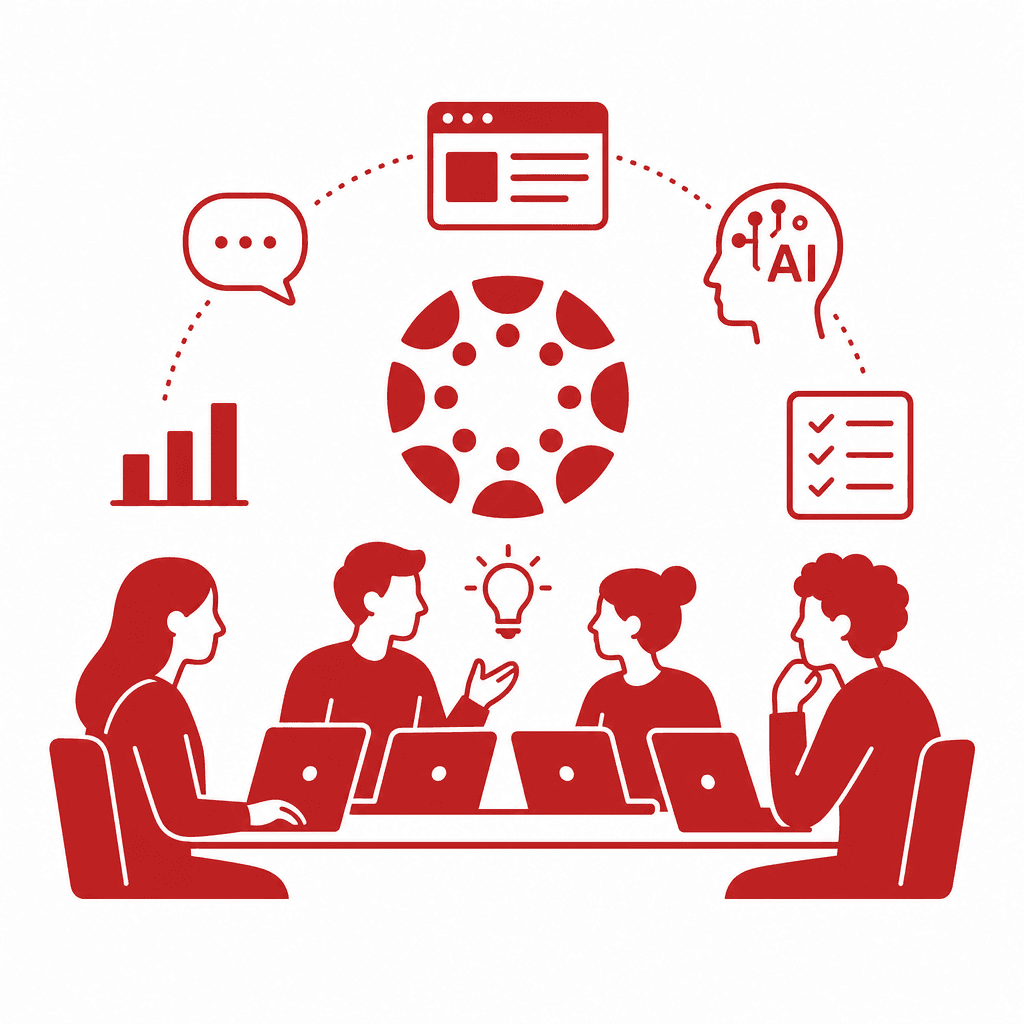
As AI technology rapidly evolves, educators face the challenge of enhancing student cognition. This article explores how to design effective learning experiences in Canvas that cultivate critical thinking and higher-order skills. By leveraging digital tools, educators can help students thrive in an AI-influenced educational landscape, ensuring they develop essential cognitive abilities for the future.
Understanding Cognitive Development
Understanding cognitive development is crucial in shaping effective educational strategies. Theories by Jean Piaget and Lev Vygotsky serve as foundational pillars in understanding how students learn and grow cognitively. Piaget emphasized stages of cognitive development, outlining how children progress from concrete to abstract thinking through active engagement with their environment. Conversely, Vygotsky highlighted the social aspect of learning, positing that cognitive development is significantly influenced by interpersonal interactions and cultural tools, including language. In a digital age enriched by AI, these theories remain relevant. Cognitive skills, such as critical thinking and problem-solving, are essential for navigating an information-saturated world. Educators play a pivotal role in fostering these skills. By designing instructional activities that require students to question, analyze, and synthesize information, educators can promote cognitive growth. Digital platforms like Canvas offer unique opportunities for engaging students through interactive assessments and collaborative learning experiences. When educators integrate these theories into their instructional design, they not only enhance cognitive abilities but also prepare students for an AI-integrated future, emphasizing the need for continuous cognitive engagement and development.
The Role of Critical Thinking in Education
Critical thinking serves as the cornerstone of education, promoting not just knowledge retention but deeper understanding and cognitive growth. It encompasses several key elements, including analysis, evaluation, inference, and problem-solving. By developing these skills, students learn to discern biases, synthesize information, and craft reasoned arguments, which are crucial in an era increasingly influenced by artificial intelligence. In this context, fostering critical thinking is not merely supplemental but essential. Measuring critical thinking can be multifaceted; rubrics, reflective essays, and performance tasks provide insight into students’ abilities to apply their knowledge in real-world scenarios. Furthermore, activities that require students to engage with diverse viewpoints can deepen their analytical abilities and promote engagement with the material. In digital learning environments, tools like Canvas can enhance opportunities for critical thinking. Interactive assignments and discussion boards can challenge students to articulate their thoughts clearly while encouraging peer evaluation. This dynamic interaction not only nurtures cognitive development but also prepares students to navigate complex information landscapes, ensuring their readiness for future academic and professional challenges. As such, educators must intentionally design experiences that spotlight and cultivate these vital skills.
Leveraging Canvas for Engaging Learning Activities
Canvas stands out as a robust learning management system (LMS) that facilitates engaging and interactive learning experiences. It offers numerous features that empower instructional designers and educators to create activities designed to challenge students’ cognitive abilities. One of its standout capabilities is the use of **discussion boards**. These forums encourage students to articulate their thoughts and engage in peer-to-peer dialogues, fostering a collaborative environment that enhances critical thinking. Additionally, Canvas's **quiz and assignment tools** allow for the construction of diverse question types, including scenario-based and reflective questions that promote analysis and evaluation. The integration of **multimedia components** enables educators to present content in various formats, appealing to different learning styles and encouraging students to synthesize information from multiple sources. Moreover, Canvas’s **collaboration tools**, such as group projects and shared documents, facilitate teamwork, requiring students to negotiate ideas, challenge assumptions, and arrive at shared conclusions. This aspect not only promotes cognitive engagement but also prepares students for the realities of an AI-integrated world, where collaboration and critical discourse are essential skills. By leveraging these features, educators can design learning experiences that not only engage students but also nurture higher-order thinking essential for cognitive development.
Designing Assessments for Higher-Order Thinking
Assessments play a crucial role in developing higher-order thinking skills, enabling students to analyze, synthesize, and evaluate information. In the context of an AI-integrated educational landscape, designing assessments that invoke deep cognitive engagement becomes imperative. Within Canvas, both formative and summative assessments can be strategically curated to enhance these skills. Formative assessments, such as interactive quizzes and peer reviews, provide ongoing opportunities for students to practice critical thinking. For instance, using Canvas’ quiz feature, educators can incorporate scenario-based questions that require students to apply knowledge in real-world contexts, thus elevating their analytical skills. Additionally, discussion boards can facilitate peer collaboration and argumentation, prompting students to articulate their thought processes and engage with diverse viewpoints. Summative assessments, like projects or presentations, can be designed to culminate students’ learning experiences. Utilizing Canvas’ rubric tools can help educators clearly outline expectations, encouraging students to delve into synthesis and evaluation. Projects that demand research and the integration of multiple sources compel learners to connect ideas, fostering a comprehensive understanding of the subject matter. By leveraging Canvas effectively, educators can design assessments that not only enhance cognitive development but also prepare students to navigate an increasingly AI-driven world.
Integrating AI Tools in Learning Experiences
As we delve into the realm of AI tools within educational frameworks, their integration presents numerous opportunities to enhance student learning experiences. When harnessed effectively, AI applications can stimulate critical thinking and bolster cognitive development. For instance, AI-driven analytics in Canvas can personalize learning pathways, allowing educators to identify areas where students may struggle and tailor support accordingly. Consider the implementation of AI chatbots that facilitate real-time engagement. A case study at a university showcased how integrating a Canvas chatbot enabled students to explore complex subjects through inquiry-based dialogue, prompting deeper evaluation of their understanding. Another example is the application of AI tools like Turnitin's Feedback Studio, which not only assesses writing but also offers insight into areas for improvement, fostering self-reflection and promoting metacognitive skills. Additionally, adaptive learning platforms within Canvas can adjust difficulty levels based on student responses, encouraging higher-order thinking by challenging learners to synthesize and apply knowledge rather than rely solely on rote memorization. By embracing these AI tools, educators can create dynamic learning environments where critical thinking thrives, ultimately preparing students for a complex, AI-integrated future.
Preparing Students for an AI-Integrated World
In preparing students for an AI-integrated world, educators must emphasize the development of critical thinking and cognitive skills. While AI can automate routine tasks and provide instantaneous information, it cannot replace the nuanced thinking and creativity inherent in human cognition. To equip students for future challenges, educators should empower them to question, analyze, and synthesize information rather than passively consume it. Strategies to foster these skills include integrating project-based learning and collaborative assignments within the Canvas environment. By designing authentic assessments that require students to solve real-world problems, educators can stimulate higher-order thinking. Discussion boards can be leveraged to encourage diverse perspectives on complex issues, prompting students to engage with material actively and critically. Furthermore, creating opportunities for self-reflection enhances metacognition, allowing learners to evaluate their understanding and approach to problem-solving. Incorporating peer feedback mechanisms within Canvas encourages students to articulate their reasoning and respond to critiques, further honing their analytical abilities. Educators bear the responsibility of cultivating an adaptive mindset in learners, where curiosity and resilience are prioritized. Fostering these cognitive tools will prepare students to thrive in a landscape increasingly shaped by AI, ensuring they remain not just consumers of technology but also capable innovators and critical thinkers.
Conclusions
In conclusion, leveraging Canvas to create engaging and challenging learning experiences is crucial for fostering students' cognitive development. By prioritizing critical thinking and higher-order skills, educators can prepare students to navigate an AI-driven world confidently. Embracing innovative instructional design practices will empower learners to thrive amidst technological advancements.
Understanding Cognitive Development
Understanding cognitive development is crucial in shaping effective educational strategies. Theories by Jean Piaget and Lev Vygotsky serve as foundational pillars in understanding how students learn and grow cognitively. Piaget emphasized stages of cognitive development, outlining how children progress from concrete to abstract thinking through active engagement with their environment. Conversely, Vygotsky highlighted the social aspect of learning, positing that cognitive development is significantly influenced by interpersonal interactions and cultural tools, including language. In a digital age enriched by AI, these theories remain relevant. Cognitive skills, such as critical thinking and problem-solving, are essential for navigating an information-saturated world. Educators play a pivotal role in fostering these skills. By designing instructional activities that require students to question, analyze, and synthesize information, educators can promote cognitive growth. Digital platforms like Canvas offer unique opportunities for engaging students through interactive assessments and collaborative learning experiences. When educators integrate these theories into their instructional design, they not only enhance cognitive abilities but also prepare students for an AI-integrated future, emphasizing the need for continuous cognitive engagement and development.
The Role of Critical Thinking in Education
Critical thinking serves as the cornerstone of education, promoting not just knowledge retention but deeper understanding and cognitive growth. It encompasses several key elements, including analysis, evaluation, inference, and problem-solving. By developing these skills, students learn to discern biases, synthesize information, and craft reasoned arguments, which are crucial in an era increasingly influenced by artificial intelligence. In this context, fostering critical thinking is not merely supplemental but essential. Measuring critical thinking can be multifaceted; rubrics, reflective essays, and performance tasks provide insight into students’ abilities to apply their knowledge in real-world scenarios. Furthermore, activities that require students to engage with diverse viewpoints can deepen their analytical abilities and promote engagement with the material. In digital learning environments, tools like Canvas can enhance opportunities for critical thinking. Interactive assignments and discussion boards can challenge students to articulate their thoughts clearly while encouraging peer evaluation. This dynamic interaction not only nurtures cognitive development but also prepares students to navigate complex information landscapes, ensuring their readiness for future academic and professional challenges. As such, educators must intentionally design experiences that spotlight and cultivate these vital skills.
Leveraging Canvas for Engaging Learning Activities
Canvas stands out as a robust learning management system (LMS) that facilitates engaging and interactive learning experiences. It offers numerous features that empower instructional designers and educators to create activities designed to challenge students’ cognitive abilities. One of its standout capabilities is the use of **discussion boards**. These forums encourage students to articulate their thoughts and engage in peer-to-peer dialogues, fostering a collaborative environment that enhances critical thinking. Additionally, Canvas's **quiz and assignment tools** allow for the construction of diverse question types, including scenario-based and reflective questions that promote analysis and evaluation. The integration of **multimedia components** enables educators to present content in various formats, appealing to different learning styles and encouraging students to synthesize information from multiple sources. Moreover, Canvas’s **collaboration tools**, such as group projects and shared documents, facilitate teamwork, requiring students to negotiate ideas, challenge assumptions, and arrive at shared conclusions. This aspect not only promotes cognitive engagement but also prepares students for the realities of an AI-integrated world, where collaboration and critical discourse are essential skills. By leveraging these features, educators can design learning experiences that not only engage students but also nurture higher-order thinking essential for cognitive development.
Designing Assessments for Higher-Order Thinking
Assessments play a crucial role in developing higher-order thinking skills, enabling students to analyze, synthesize, and evaluate information. In the context of an AI-integrated educational landscape, designing assessments that invoke deep cognitive engagement becomes imperative. Within Canvas, both formative and summative assessments can be strategically curated to enhance these skills. Formative assessments, such as interactive quizzes and peer reviews, provide ongoing opportunities for students to practice critical thinking. For instance, using Canvas’ quiz feature, educators can incorporate scenario-based questions that require students to apply knowledge in real-world contexts, thus elevating their analytical skills. Additionally, discussion boards can facilitate peer collaboration and argumentation, prompting students to articulate their thought processes and engage with diverse viewpoints. Summative assessments, like projects or presentations, can be designed to culminate students’ learning experiences. Utilizing Canvas’ rubric tools can help educators clearly outline expectations, encouraging students to delve into synthesis and evaluation. Projects that demand research and the integration of multiple sources compel learners to connect ideas, fostering a comprehensive understanding of the subject matter. By leveraging Canvas effectively, educators can design assessments that not only enhance cognitive development but also prepare students to navigate an increasingly AI-driven world.
Integrating AI Tools in Learning Experiences
As we delve into the realm of AI tools within educational frameworks, their integration presents numerous opportunities to enhance student learning experiences. When harnessed effectively, AI applications can stimulate critical thinking and bolster cognitive development. For instance, AI-driven analytics in Canvas can personalize learning pathways, allowing educators to identify areas where students may struggle and tailor support accordingly. Consider the implementation of AI chatbots that facilitate real-time engagement. A case study at a university showcased how integrating a Canvas chatbot enabled students to explore complex subjects through inquiry-based dialogue, prompting deeper evaluation of their understanding. Another example is the application of AI tools like Turnitin's Feedback Studio, which not only assesses writing but also offers insight into areas for improvement, fostering self-reflection and promoting metacognitive skills. Additionally, adaptive learning platforms within Canvas can adjust difficulty levels based on student responses, encouraging higher-order thinking by challenging learners to synthesize and apply knowledge rather than rely solely on rote memorization. By embracing these AI tools, educators can create dynamic learning environments where critical thinking thrives, ultimately preparing students for a complex, AI-integrated future.
Preparing Students for an AI-Integrated World
In preparing students for an AI-integrated world, educators must emphasize the development of critical thinking and cognitive skills. While AI can automate routine tasks and provide instantaneous information, it cannot replace the nuanced thinking and creativity inherent in human cognition. To equip students for future challenges, educators should empower them to question, analyze, and synthesize information rather than passively consume it. Strategies to foster these skills include integrating project-based learning and collaborative assignments within the Canvas environment. By designing authentic assessments that require students to solve real-world problems, educators can stimulate higher-order thinking. Discussion boards can be leveraged to encourage diverse perspectives on complex issues, prompting students to engage with material actively and critically. Furthermore, creating opportunities for self-reflection enhances metacognition, allowing learners to evaluate their understanding and approach to problem-solving. Incorporating peer feedback mechanisms within Canvas encourages students to articulate their reasoning and respond to critiques, further honing their analytical abilities. Educators bear the responsibility of cultivating an adaptive mindset in learners, where curiosity and resilience are prioritized. Fostering these cognitive tools will prepare students to thrive in a landscape increasingly shaped by AI, ensuring they remain not just consumers of technology but also capable innovators and critical thinkers.
Conclusions
In conclusion, leveraging Canvas to create engaging and challenging learning experiences is crucial for fostering students' cognitive development. By prioritizing critical thinking and higher-order skills, educators can prepare students to navigate an AI-driven world confidently. Embracing innovative instructional design practices will empower learners to thrive amidst technological advancements.