
Instructional Design First: Why AI Personalization Fails in Canvas Without Strong Pedagogy
Explore evidence-based reasons why AI personalization initiatives in Canvas often falter without a robust instructional design framework. This guide provides actionable strategies for educators and instructional designers to embed pedagogical principles, ensuring AI tools truly enhance learning outcomes and learner experience, rather than merely automating content delivery.
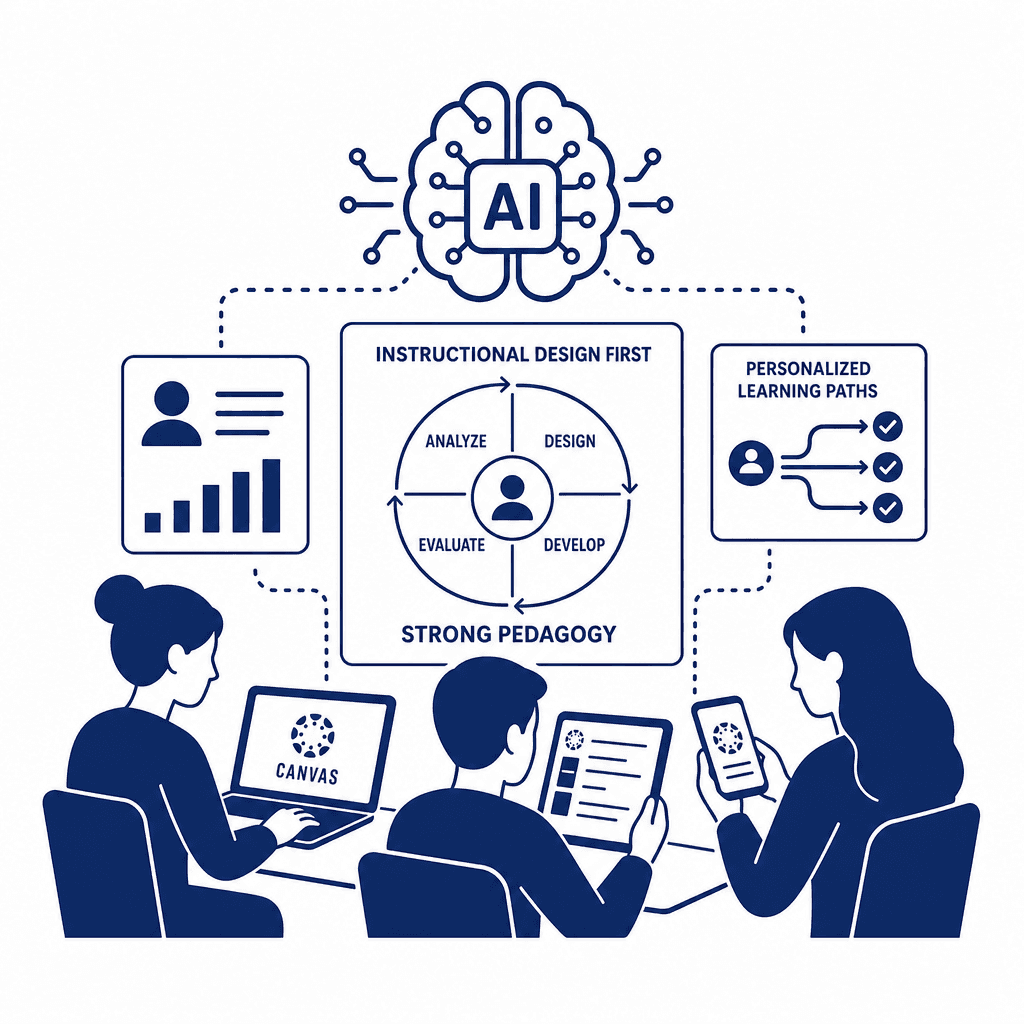
In the rapidly evolving landscape of educational technology, AI personalization in platforms like Canvas offers exciting potential. However, this potential often goes unrealized due to a lack of strong pedagogical frameworks. This article delves into the intersection of AI, instructional design, and pedagogy, providing insights and strategies to improve learning outcomes through effective implementation of AI tools.
Understanding AI Personalization in Education
AI personalization in education has garnered significant attention as a means to tailor learning experiences to individual student needs. By leveraging machine learning algorithms and data analytics, platforms like Canvas LMS aim to facilitate personalized pathways, adapting to learner behaviors, preferences, and performance metrics. The potential benefits are vast: from improving engagement and motivation to increasing retention rates and academic success. Personalized learning environments can streamline content delivery, making learning more relevant to students, which, in turn, encourages deeper understanding and application of knowledge. Despite the promise of AI in education, the deployment of such technologies faces challenges. One major hurdle is the inconsistency in data quality and availability, which can lead to ineffective personalization strategies. Moreover, while AI tools enable customization, they lack the pedagogical foundation to ensure that these enhancements facilitate meaningful learning experiences. For instance, without understanding the context and nuances of individual learning styles, data-driven recommendations may diverge from educational goals, resulting in superficial learning gains rather than the transformative outcomes envisioned. As such, a robust framework integrating instructional design principles is essential for AI personalization to flourish effectively within education.
The Role of Instructional Design
The essence of instructional design lies in its structured approach to creating effective and engaging educational experiences. Instructional design can be defined as the systematic process of translating principles of learning and instruction into plans for instructional materials and activities. This methodology is crucial in ensuring that educational interventions are purposeful and tailored to meet the diverse needs of learners. Key principles from established frameworks, such as ADDIE (Analysis, Design, Development, Implementation, Evaluation) and SAM (Successive Approximation Model), play a pivotal role in guiding the integration of AI personalization in platforms like Canvas. These principles promote a thorough analysis of learner needs and context, which is essential for crafting relevant content that aligns with learning outcomes. For instance, by applying the ADDIE framework, educators can design AI-driven interventions that measure learner engagement and knowledge acquisition, thereby iteratively improving the educational experience. When AI personalization initiatives are grounded in strong instructional design principles, they not only enhance individual learning journeys but also ensure that learning objectives are met effectively. This synergy between AI tools and pedagogical strategies fosters an environment where learning is not simply about automation, but rather an enriched experience that drives meaningful outcomes.
Challenges of AI Personalization Without Strong Pedagogy
The implementation of AI personalization in Canvas often encounters numerous challenges without a foundational pedagogical framework. One of the primary pitfalls is the tendency for automation to overshadow authentic personalization. Instead of tailoring learning experiences to individual needs, AI tools may simply automate the distribution of content, leading to a one-size-fits-all approach that fails to engage learners meaningfully. Moreover, disengagement can arise when instructional strategies are absent. For example, an initiative that utilized AI to assign tasks based on past performance overlooked the importance of varied pedagogical methods, resulting in students feeling unchallenged or disconnected from the material. This disengagement is particularly pronounced among diverse learners who may require different approaches to grasp complex concepts. Additionally, there lies the risk of reinforcing existing biases within learning data. AI tools can perpetuate ineffective learning patterns rather than adapting to students' unique contexts. A case study of a university that integrated AI-driven assessment highlighted how it inadvertently disadvantaged underrepresented student groups because it relied heavily on historical performance data, failing to consider the broader educational landscape. These cases underscore the necessity of embedding robust instructional design principles in AI personalization initiatives, ensuring that technology enhances rather than detracts from learning outcomes.
Pedagogical Principles in AI-Driven Learning
Integrating pedagogical principles into AI personalization frameworks within Canvas is crucial for fostering meaningful educational experiences. Central to this approach is **Constructivism**, which emphasizes that learners construct knowledge through experiences and interactions. By leveraging AI tools that adapt to individual learning paths, educators can create environments where students actively engage with content rather than passively receiving information. For example, AI could recommend resources tailored to each student’s interests and prior knowledge, encouraging deeper exploration of concepts. **Connectivism**, on the other hand, highlights the importance of networks and the learning that occurs through these connections. AI can facilitate networking among peers by suggesting collaborative projects based on shared interests or complementary skills. Such strategies ensure that learners are not isolated in their educational journeys but are part of a dynamic community. Lastly, **Universal Design for Learning (UDL)** champion the need for flexible learning environments that accommodate various learners. AI personalization can enhance UDL by providing multiple means of engagement, representation, and action. For instance, AI systems can adapt assessments to suit diverse learning profiles, offering options that reflect each learner's strengths and challenges. By grounding AI initiatives in these pedagogical principles, educators can guarantee that technology not only supports but enhances learning outcomes in Canvas.
Strategies for Effective Integration
To effectively integrate AI tools in Canvas, educators and instructional designers must adopt actionable strategies that infuse pedagogical principles throughout the implementation process. Collaborative planning among stakeholders is essential. By engaging faculty, instructional designers, and technology experts, institutions can outline shared objectives and ensure that AI tools serve educational purposes, rather than merely automating tasks. Continuous assessment and feedback loops form the backbone of adaptive learning environments. Incorporating regular evaluations allows educators to gauge AI tools’ effectiveness and make necessary adjustments to meet diverse learner needs. This iterative process encourages responsiveness to learner feedback, helping tailor experiences more precisely. Additionally, fostering a culture of experimentation and adaptation is vital. Professional development opportunities should emphasize these concepts, offering educators the space to explore innovative strategies and assess their impact on student learning. By building a workforce comfortable with trial and error, institutions can develop resilience and flexibility in their AI-driven initiatives. The combination of collaborative planning, continuous assessment, and a commitment to professional growth creates a robust framework that enhances the potential of AI personalization in Canvas, ultimately refining learning outcomes for every student.
Measuring Success in AI Personalization Initiatives
To effectively measure the success of AI personalization initiatives within Canvas, it is essential to employ a multi-faceted approach. Utilizing both qualitative and quantitative metrics provides a comprehensive view of how these tools impact learning outcomes. **Quantitative metrics** may include data such as course completion rates, average grades, and assessment scores. Tracking student engagement through analytics that monitor time spent on tasks or frequency of logins helps educators identify patterns in behavior that correlate with successful outcomes. **Qualitative metrics**, on the other hand, can be gathered through student surveys, focus groups, and open feedback forums. Questions should assess perceived relevance and effectiveness of personalized learning pathways, including whether students feel the AI tools enhance their understanding of course material. Moreover, ongoing evaluation is crucial. Periodic reviews should be established to analyze collected data, allowing for real-time adjustments in instructional strategies. An iterative approach not only fine-tunes AI personalization but also ensures alignment with broader educational goals. By fostering a climate of adaptability and continuous improvement, educators can maximize the effectiveness of AI tools, ultimately enhancing the overall learning experience for students in Canvas.
Conclusions
As AI personalization continues to shape the future of education, grounding its implementation in robust instructional design is essential. By prioritizing pedagogy, educators can enhance learning experiences and outcomes, transforming AI tools from mere content delivery systems into powerful catalysts for student engagement and success.
Understanding AI Personalization in Education
AI personalization in education has garnered significant attention as a means to tailor learning experiences to individual student needs. By leveraging machine learning algorithms and data analytics, platforms like Canvas LMS aim to facilitate personalized pathways, adapting to learner behaviors, preferences, and performance metrics. The potential benefits are vast: from improving engagement and motivation to increasing retention rates and academic success. Personalized learning environments can streamline content delivery, making learning more relevant to students, which, in turn, encourages deeper understanding and application of knowledge. Despite the promise of AI in education, the deployment of such technologies faces challenges. One major hurdle is the inconsistency in data quality and availability, which can lead to ineffective personalization strategies. Moreover, while AI tools enable customization, they lack the pedagogical foundation to ensure that these enhancements facilitate meaningful learning experiences. For instance, without understanding the context and nuances of individual learning styles, data-driven recommendations may diverge from educational goals, resulting in superficial learning gains rather than the transformative outcomes envisioned. As such, a robust framework integrating instructional design principles is essential for AI personalization to flourish effectively within education.
The Role of Instructional Design
The essence of instructional design lies in its structured approach to creating effective and engaging educational experiences. Instructional design can be defined as the systematic process of translating principles of learning and instruction into plans for instructional materials and activities. This methodology is crucial in ensuring that educational interventions are purposeful and tailored to meet the diverse needs of learners. Key principles from established frameworks, such as ADDIE (Analysis, Design, Development, Implementation, Evaluation) and SAM (Successive Approximation Model), play a pivotal role in guiding the integration of AI personalization in platforms like Canvas. These principles promote a thorough analysis of learner needs and context, which is essential for crafting relevant content that aligns with learning outcomes. For instance, by applying the ADDIE framework, educators can design AI-driven interventions that measure learner engagement and knowledge acquisition, thereby iteratively improving the educational experience. When AI personalization initiatives are grounded in strong instructional design principles, they not only enhance individual learning journeys but also ensure that learning objectives are met effectively. This synergy between AI tools and pedagogical strategies fosters an environment where learning is not simply about automation, but rather an enriched experience that drives meaningful outcomes.
Challenges of AI Personalization Without Strong Pedagogy
The implementation of AI personalization in Canvas often encounters numerous challenges without a foundational pedagogical framework. One of the primary pitfalls is the tendency for automation to overshadow authentic personalization. Instead of tailoring learning experiences to individual needs, AI tools may simply automate the distribution of content, leading to a one-size-fits-all approach that fails to engage learners meaningfully. Moreover, disengagement can arise when instructional strategies are absent. For example, an initiative that utilized AI to assign tasks based on past performance overlooked the importance of varied pedagogical methods, resulting in students feeling unchallenged or disconnected from the material. This disengagement is particularly pronounced among diverse learners who may require different approaches to grasp complex concepts. Additionally, there lies the risk of reinforcing existing biases within learning data. AI tools can perpetuate ineffective learning patterns rather than adapting to students' unique contexts. A case study of a university that integrated AI-driven assessment highlighted how it inadvertently disadvantaged underrepresented student groups because it relied heavily on historical performance data, failing to consider the broader educational landscape. These cases underscore the necessity of embedding robust instructional design principles in AI personalization initiatives, ensuring that technology enhances rather than detracts from learning outcomes.
Pedagogical Principles in AI-Driven Learning
Integrating pedagogical principles into AI personalization frameworks within Canvas is crucial for fostering meaningful educational experiences. Central to this approach is **Constructivism**, which emphasizes that learners construct knowledge through experiences and interactions. By leveraging AI tools that adapt to individual learning paths, educators can create environments where students actively engage with content rather than passively receiving information. For example, AI could recommend resources tailored to each student’s interests and prior knowledge, encouraging deeper exploration of concepts. **Connectivism**, on the other hand, highlights the importance of networks and the learning that occurs through these connections. AI can facilitate networking among peers by suggesting collaborative projects based on shared interests or complementary skills. Such strategies ensure that learners are not isolated in their educational journeys but are part of a dynamic community. Lastly, **Universal Design for Learning (UDL)** champion the need for flexible learning environments that accommodate various learners. AI personalization can enhance UDL by providing multiple means of engagement, representation, and action. For instance, AI systems can adapt assessments to suit diverse learning profiles, offering options that reflect each learner's strengths and challenges. By grounding AI initiatives in these pedagogical principles, educators can guarantee that technology not only supports but enhances learning outcomes in Canvas.
Strategies for Effective Integration
To effectively integrate AI tools in Canvas, educators and instructional designers must adopt actionable strategies that infuse pedagogical principles throughout the implementation process. Collaborative planning among stakeholders is essential. By engaging faculty, instructional designers, and technology experts, institutions can outline shared objectives and ensure that AI tools serve educational purposes, rather than merely automating tasks. Continuous assessment and feedback loops form the backbone of adaptive learning environments. Incorporating regular evaluations allows educators to gauge AI tools’ effectiveness and make necessary adjustments to meet diverse learner needs. This iterative process encourages responsiveness to learner feedback, helping tailor experiences more precisely. Additionally, fostering a culture of experimentation and adaptation is vital. Professional development opportunities should emphasize these concepts, offering educators the space to explore innovative strategies and assess their impact on student learning. By building a workforce comfortable with trial and error, institutions can develop resilience and flexibility in their AI-driven initiatives. The combination of collaborative planning, continuous assessment, and a commitment to professional growth creates a robust framework that enhances the potential of AI personalization in Canvas, ultimately refining learning outcomes for every student.
Measuring Success in AI Personalization Initiatives
To effectively measure the success of AI personalization initiatives within Canvas, it is essential to employ a multi-faceted approach. Utilizing both qualitative and quantitative metrics provides a comprehensive view of how these tools impact learning outcomes. **Quantitative metrics** may include data such as course completion rates, average grades, and assessment scores. Tracking student engagement through analytics that monitor time spent on tasks or frequency of logins helps educators identify patterns in behavior that correlate with successful outcomes. **Qualitative metrics**, on the other hand, can be gathered through student surveys, focus groups, and open feedback forums. Questions should assess perceived relevance and effectiveness of personalized learning pathways, including whether students feel the AI tools enhance their understanding of course material. Moreover, ongoing evaluation is crucial. Periodic reviews should be established to analyze collected data, allowing for real-time adjustments in instructional strategies. An iterative approach not only fine-tunes AI personalization but also ensures alignment with broader educational goals. By fostering a climate of adaptability and continuous improvement, educators can maximize the effectiveness of AI tools, ultimately enhancing the overall learning experience for students in Canvas.
Conclusions
As AI personalization continues to shape the future of education, grounding its implementation in robust instructional design is essential. By prioritizing pedagogy, educators can enhance learning experiences and outcomes, transforming AI tools from mere content delivery systems into powerful catalysts for student engagement and success.